
Long-term perspective: I bought the Gustard X20u in 2016 after spending some time with the much cheaper SMSL M8. What started as curiosity about an ambitious Chinese DAC turned into several years of ownership. The X20u became my reference DAC, survived comparisons with far more expensive equipment and remained in my system until the RME ADI-2 Pro FS R replaced it in 2020.
Quick Verdict
The Gustard X20u is one of the products that changed the way I think about high-end audio. When I bought it in 2016 for around $800, I was expecting an improvement over my SMSL M8. I was not expecting a heavily built, fully balanced DAC with two ESS9018 converters, a substantial internal power supply and performance that would make me question how closely price and sound quality were really connected.
I was extremely enthusiastic about it in my original review. Some of the language I used back then — including calling it one of the world’s best DACs — was stronger than I would use today. What has not changed is the underlying experience: the X20u sounded excellent, remained my reference for years and never left me feeling that I needed a more prestigious brand.
It is now an old and discontinued DAC. There is no integrated streaming, no analog input, no modern app and no headphone amplifier. Yet as a straightforward digital source with balanced outputs, multiple inputs and variable volume, it still represents an interesting example of how quickly Chinese audio manufacturers changed the high-end market.
My conclusion: I would not tell someone in 2026 to hunt down a Gustard X20u because it is secretly better than every modern DAC. I would say that it was one of the components that taught me to stop using price, country of origin and brand prestige as shortcuts for judging audio quality.
Why I Bought the Gustard X20u
The story starts with the SMSL M8.
That little DAC had already challenged some of my assumptions about affordable Chinese audio equipment. It was compact, inexpensive and sounded much better than its price suggested. I liked it enough that the rational thing would probably have been to stop looking.
Naturally, I did the opposite.
I became curious about what would happen if a Chinese manufacturer applied the same value-oriented approach to a genuinely ambitious full-size DAC. At the time, Gustard was receiving a lot of attention in enthusiast forums, and the X20u looked very different from the inexpensive desktop converters I had been experimenting with.
It cost around $800 when I bought mine in 2016. That was much more expensive than the SMSL, but still inexpensive compared with many DACs being marketed as reference-class products.
On paper, the Gustard looked almost excessive for the money: two ESS Sabre32 ES9018 converter chips, a fully balanced architecture, substantial linear power supplies, balanced XLR outputs, several digital inputs and remote-controlled volume.
I was interested in the specifications, but I mainly wanted to answer a simpler question:
How much better could a DAC actually get once I had already reached the level of something like the SMSL M8?
I expected the answer to be “a little.”
My first reaction was considerably stronger than that.
Build Quality and Internal Design
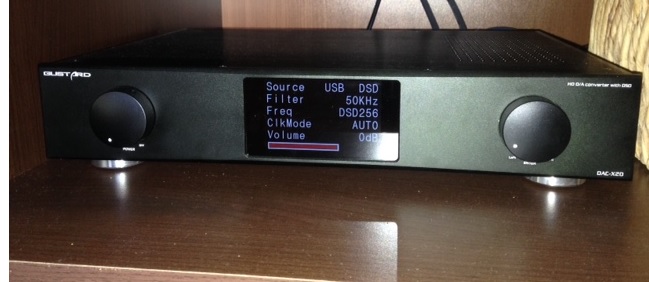
One thing was obvious before I even listened to the X20u: Gustard had not built it like a budget DAC.
The enclosure was substantial and much closer to conventional full-size hi-fi equipment than to the small external DACs that were becoming popular at the time. The front panel was thick, the connectors felt solid and the unit had enough weight to make the price seem surprisingly modest.
Inside were two ESS Sabre32 ES9018 DAC chips. Rather than using a single converter for both channels, Gustard implemented a dual-chip architecture as part of a fully balanced design.
The power supply was equally serious. Two internal toroidal transformers were used to separate the power requirements of the different sections of the DAC instead of relying on a small external wall adapter.
That does not automatically make a DAC sound better. A large transformer and an impressive parts count are no guarantee of good engineering. But at the time, it was difficult to ignore how much hardware Gustard was putting into a product at this price.
The X20u also helped change my perception of Chinese hi-fi construction. Earlier Chinese products I had used often provided excellent value because they were simple: a good DAC chip, a basic enclosure and just enough supporting circuitry to get the job done.
The Gustard was different. It looked and felt like somebody had decided to build a serious high-end component and then price it according to a completely different set of rules.
Inputs, Outputs and Preamp Function
The X20u was also unusually flexible for a pure DAC of its generation.
| Function | What the X20u Offered |
|---|---|
| DAC architecture | Dual ESS Sabre32 ES9018 converters in a balanced design |
| USB | Dedicated XMOS-based USB interface |
| Digital inputs | USB, coaxial SPDIF, BNC, optical and HDMI-style I2S |
| Analog outputs | Balanced XLR and unbalanced RCA |
| Volume control | Remote-controllable variable output allowing direct connection to a power amplifier |
| User adjustments | Selectable filters, clock modes, phase and gain-related settings |
The digital volume control meant that I could use the Gustard without a conventional preamp in an all-digital system.
That became increasingly important as my system evolved. I have never been particularly interested in adding another component simply because hi-fi tradition says a system should contain one. If a DAC can control volume properly and provide enough output to drive the next stage, I am perfectly happy to connect it directly.
The X20u did exactly that.
There was one reminder of its price point: the remote control. The DAC itself felt far more expensive than it was, while the remote looked and felt cheap.
It worked, though, and I would rather have Gustard spend money on the electronics than on a kilogram of machined aluminum for changing the volume from my sofa.
How I Used the Gustard X20u in My System
The X20u was not tested for a weekend and returned. It became part of my regular system.
For headphone listening, I used its balanced outputs with my KGSSHV electrostatic amplifier and STAX headphones. That was an extremely revealing combination and made differences in recordings, mastering and source components easy to hear.
You can read more about that side of my system in my long-term STAX article.
My digital sources changed over the years. A Raspberry Pi was an important part of the system, initially feeding the DAC through conventional digital connections and later through the Singxer SU-1.
I also used the Gustard as a preamp. Its variable output could feed my power amplifiers directly, including the DIY Hypex NCore amplifiers I used in my loudspeaker system.
That made the X20u much more than a box sitting between a computer and an amplifier. For several years it was effectively the center of my digital playback system.
Gustard X20u vs SMSL M8
This was the comparison that surprised me most when the X20u first arrived.
I already thought the SMSL M8 was very good. More importantly, I had learned from previous DAC comparisons that differences between competent digital converters were usually smaller than audiophile marketing suggested.
The Gustard nevertheless made a stronger first impression than I expected.
Through my STAX system, I heard a larger and deeper soundstage and more low-level information. The presentation seemed less confined around my head, while individual instruments were easier to place within the recording.
I also felt that the Gustard retrieved detail without making the music sound artificially sharpened.
My original review described the result in much more dramatic terms and said the X20u “handily bested” the SMSL.
With another decade of experience, I would phrase that differently.
The differences between two competent DACs are small compared with changing headphones, loudspeakers or even the mastering of an album. The SMSL remained an excellent product for the money. But in my system, I consistently preferred the Gustard and felt that the improvement was large enough to justify keeping it.
That distinction matters.
The X20u did not make the SMSL suddenly sound bad. It showed me what another step in implementation, power supply, output stage and overall engineering could add once the basic digital conversion was already good.
The Weiss DAC202 Comparison
This is the part of my original review that attracted the most attention.
After hearing what the Gustard did in my own system, I took it to a friend’s house. He owned a Weiss DAC202, a highly regarded Swiss DAC that cost around €7,000 at the time.
I wanted to find out how embarrassing the comparison would be for my $800 Chinese DAC.
It wasn’t embarrassing at all.
During that listening session, I actually preferred the Gustard slightly. Bass performance seemed roughly comparable, while I felt the X20u gave me at least as much detail and spatial information.
That result completely challenged my expectations.
My 2016 article treated it almost as proof that the Gustard had beaten a DAC costing close to ten times as much. Looking back, that framing gave a casual listening session more authority than it deserved.
It was not a controlled laboratory test. We were not conducting a properly blinded comparison designed to establish whether listeners could reliably identify one DAC from the other. Differences in level, setup and expectation can easily influence this kind of listening session.
What I can say is exactly what happened: I listened to both products and did not prefer the expensive one. At the time, I slightly preferred the Gustard.
That was important because it broke an assumption I had carried into the comparison.
I had expected the Weiss to demonstrate why a high-end European DAC could cost several times more. Instead, I came away wondering how much of the price difference was actually relevant to what I had just heard.
How I interpret that comparison today:
I do not consider a sighted listening session from 2016 proof that the Gustard X20u is objectively superior to the Weiss DAC202. I do consider it proof that spending dramatically more money did not automatically give me a sound I preferred. That lesson has stayed with me ever since.
Living With the X20u
The most useful review of any component begins after the excitement of the first week has disappeared.
The Gustard stayed.
Over several years, I came to know its presentation extremely well. I would describe it as detailed, spacious and balanced rather than warm or deliberately forgiving.
It was capable of revealing small recording cues through my STAX system: the space around voices, a singer taking a breath, the decay of instruments and the acoustic character of the recording venue.
At the same time, it did not strike me as aggressively bright in the way some early Sabre-based products were sometimes described.
Bass was controlled and extended, although I never regarded bass character as the defining feature of the DAC. Its strongest quality for me was spatial resolution — the ability to make a recording feel less flat.
That said, it did not turn every recording into an audiophile demonstration.
A poor master remained poor. A compressed recording remained compressed. In fact, a revealing DAC and electrostatic headphone system often made those limitations easier to hear.
What mattered was that after the novelty wore off, I never had the urge to replace the Gustard simply because another expensive DAC appeared in a magazine or forum thread.
That may be the strongest compliment I can give it.
Filters, Clock Modes and Tweaking
The X20u provided several user-adjustable options, including different digital filters and clock-related modes.
Naturally, I tried them.
I could sometimes convince myself that changing a setting produced a small difference. One filter might appear slightly softer, another a little more explicit. Switching clock modes could create similarly subtle impressions.
The DAC itself, though, stayed the DAC. Nothing in the menu came close to changing its fundamental character.
After experimenting for a while, I stopped treating the menu as a source of entertainment and simply used the settings I preferred.
That experience is worth remembering because the audiophile world has a habit of turning small configuration options into major upgrade paths. The X20u sounded like the X20u regardless of which filter I selected.
There were also extensive discussions online about modifying the DAC. Owners changed clocks, regulators, capacitors, USB boards and parts of the power supply.
I left mine essentially stock.
Once a product already sounds excellent, I am reluctant to turn a reliable commercial component into an undocumented DIY experiment just to chase a theoretical final percentage.
Adding the Singxer SU-1 and I2S
I did eventually change the digital front end, but without modifying the Gustard itself.
In 2017 I bought a Singxer SU-1 USB DDC.
The idea was simple. The Raspberry Pi fed the Singxer through USB, the Singxer handled isolation and clocking, and its HDMI-style I2S output connected directly to the Gustard’s I2S input.
The combination worked immediately.
Using my STAX SR-007 MK1 and KGSSHV, I felt that the Singxer added a little more depth and made quiet ambience in recordings easier to follow. Switching back to the previous digital connection reduced some of those spatial cues.
I was enthusiastic about the improvement at the time, but this is another area where my language has become more careful over the years.
It was not night and day.
The Singxer did not turn an average DAC into a great one. The X20u was already excellent. What I heard was a relatively small refinement in an extremely revealing system.
For somebody using modest speakers or headphones, I would still put the money into the transducers first.
That was true in 2017 and it is even more true today.
What Cheaper DACs Later Taught Me
Something interesting happened during the years I owned the Gustard: inexpensive DACs kept improving.
In 2019, I compared the X20u with a very inexpensive Hifimediy DAC. The cheap device came surprisingly close.
The Gustard still sounded better to me. It was more balanced, less prone to making vocals sound sibilant and gave me clearer spatial cues through the STAX system.
But the difference was not remotely proportional to the difference in price, construction or features.
That comparison reinforced something the SMSL M8 had already taught me. Once a DAC is competently designed, spending more money increasingly buys smaller improvements along with better construction, more inputs, balanced outputs, volume control and other features.
The Gustard justified itself because I used those things. It was not merely an expensive converter chip in a large box.
This is also why I no longer recommend climbing through a long sequence of incremental DAC upgrades. Starting with an affordable competent DAC and spending the majority of the budget on better headphones, loudspeakers and room setup generally makes more sense.
I discuss that in more detail in Cheap DAC vs Expensive DAC and my current DAC Buyer’s Guide.
X20Pro, X22 and the Upgrade Cycle
Gustard did not stop developing DACs after the X20u.
The X20Pro appeared shortly afterward with a newer generation of ESS converters, and later models such as the X22 continued the line.
I mentioned those products in updates to the original article, but I did not replace my X20u simply because a successor appeared.
That is an important distinction when reading old hi-fi reviews.
A manufacturer releasing a new DAC does not cause the previous one to lose resolution overnight. The X20u continued to sound exactly as it had the day before the new model was announced.
I never heard enough from the X20Pro to claim that owners of the original X20u needed to upgrade, so I am not going to rewrite history now and pretend otherwise.
The specific models have long since moved on, but the product cycle has not. Gustard continues to build newer and more sophisticated DACs, while manufacturers such as SMSL, Topping and Eversolo have pushed the same segment forward.
That makes the X20u historically more interesting to me, not less.
Why the RME Eventually Replaced It
By 2020, the Gustard had been my reference DAC for several years.
I did eventually replace it with an RME ADI-2 Pro FS R Black Edition, but the reason is important.
I had started listening to vinyl and wanted an analog input and a high-quality analog-to-digital converter. My idea was to connect my phono stage, digitize parts of my record collection and keep the entire system centered around one digital device.
The Gustard could not do that. It had no analog input and no ADC.
The RME did.
It also added extensive DSP, professional recording functions and a very capable conventional headphone amplifier.
On paper, moving from an older Chinese DAC to a much newer professional RME product also looked like an obvious upgrade.
Sonically, it was not that simple.
I never felt that the RME clearly surpassed the Gustard as a DAC. At times I preferred the X20u, finding it a little fuller and more involving — though this was casual home listening, not a blind test, so I hold that impression loosely.
The RME stayed because it solved a different problem.
That eventually became a recurring theme in my system. In 2024 the Eversolo DMP-A8 replaced the RME for much the same reason: not because the previous component had suddenly become bad, but because what I needed from the center of my system had changed again.
| Period | Main Digital Component | Why I Used It |
|---|---|---|
| 2016 | SMSL M8 | Compact, inexpensive and surprisingly capable digital playback |
| 2016–2020 | Gustard X20u | Higher-end DAC performance, balanced output, multiple inputs and preamp capability |
| 2020–2024 | RME ADI-2 Pro FS R | DAC, ADC, analog input, recording, DSP, preamp and headphone functions |
| 2024 onward | Eversolo DMP-A8 | Integrated streaming, local storage, DAC, analog preamp and simpler daily operation |
Seen this way, these were not four attempts to buy progressively “better sounding” DACs. They were four stages in how I built and used my system.
How the Gustard Changed My View of High-End Hi-Fi
This is the real reason I still consider the X20u an important product in my audio history.
Before owning it, I had already built DIY equipment and used inexpensive Chinese DACs, so I was not completely obsessed with prestigious brands.
Still, part of me assumed that a serious reference product from Europe or the United States would occupy another performance category.
The Gustard made that assumption difficult to maintain.
It had a substantial chassis, a serious power supply, balanced circuitry, good connectivity and sound quality that left me with no desire to replace it for several years.
Then I compared it with the Weiss and did not prefer the Weiss.
Later I bought the RME and again discovered that paying more for a respected Western professional brand did not automatically result in a DAC I preferred.
I am not suggesting Chinese manufacturers have some secret formula for better sound, and I am not writing off expensive European and American components either. What I take from all of it is simpler: country of origin and retail price turned out to be poor substitutes for evaluating the actual product in front of me.
That seems obvious to me now. It was much less obvious to me in 2016.
Today, seeing technically ambitious equipment from Gustard, Topping, SMSL and Eversolo feels normal. The market was different when I bought the X20u, and that is part of why the product made such an impression on me.
Buying a Gustard X20u Used Today
I would approach the X20u very differently as a purchase in 2026 than I did in 2016.
It is now a legacy product. I would buy one only as a sensibly priced used DAC, not because an old review calls it a “giant killer.”
The good news is that the core functions do not depend on a cloud service or proprietary streaming app. USB compatibility aside, the DAC does not become useless because somebody stops maintaining a smartphone application.
The downside is age.
Before buying one, I would check:
- both RCA and XLR outputs for correct channel balance,
- the display and front-panel controls,
- the remote control and volume adjustment,
- all digital inputs you actually intend to use,
- USB compatibility with your current computer or streamer,
- the correct mains-voltage version for your country,
- and whether the unit has been modified internally.
That last point matters to me.
There were many modification projects around the X20 and X20u. A carefully executed modification may be perfectly fine, but I would rather buy an original unit than inherit somebody else’s undocumented experiment.
A collector’s premium is also something I’d skip. Modern DACs have improved enormously, and excellent measured performance is now available for very little money.
The attraction of a used X20u is the combination of its substantial construction, balanced outputs, connectivity and straightforward operation — not the belief that an ES9018 chip from a decade ago contains some lost digital magic.
Who Is the Gustard X20u Still For?
A used X20u can still make sense for a particular kind of system.
It Still Makes Sense If You Want
- A substantial full-size standalone DAC
- Balanced XLR outputs
- Several conventional digital inputs
- I2S connectivity for compatible digital sources
- Variable output for direct connection to a power amplifier
- A device that does not depend on streaming software or cloud services
- A well-priced used component rather than the latest model
I Would Look Elsewhere If You Need
- Integrated Qobuz, Tidal or other streaming services
- Internal music storage
- An analog input
- A built-in headphone amplifier
- Parametric EQ or advanced DSP
- A modern app-based interface
- Current manufacturer warranty and long-term software support
For someone starting from scratch today, I would normally begin with current products instead. My DAC Buyer’s Guide covers the choices I consider more relevant now.
But if an original X20u appeared locally at a sensible used price and I needed a straightforward balanced DAC, I would have no problem using one again.
Final Verdict: What the Gustard X20u Means to Me Today
I bought the Gustard X20u in 2016 because I wanted to find out what happened when I moved beyond the inexpensive SMSL M8.
I expected a better DAC.
What I got was a component that changed how I judged audio equipment.
The X20u sounded excellent in my system, worked particularly well with my STAX and KGSSHV setup and remained my reference DAC for roughly four years. Adding the Singxer SU-1 later extracted a little more from it, but the fundamental quality was already there.
My comparison with the Weiss DAC202 was probably the turning point. I went into that session assuming the much more expensive DAC should clearly demonstrate its superiority. I came out preferring the Gustard.
Looking back at how I described that listening session in the original article — practically crowning the X20u the “world’s best DAC” — I can see the enthusiasm talking more than the evidence.
But the lesson behind the enthusiasm was real.
Price did not predict my preference. Brand prestige did not predict it either. And the words “Made in China” certainly did not tell me how serious the engineering inside the box was.
The RME ADI-2 Pro eventually replaced the Gustard because I needed an analog input, ADC, DSP and recording functions. It was a change in system architecture, not the moment the X20u suddenly stopped sounding good.
Four years after that, the Eversolo replaced the RME because my priorities changed again.
Looking back, that progression tells me more than another list of DAC specifications ever could.
What stuck with me from the X20u was never really about how it stacks up against today’s DACs. It was 2016, and a $800 Chinese DAC just quietly out-performed my assumptions about what price, reputation and country of origin were supposed to guarantee.
Last updated: August 2026. I bought the Gustard X20u myself in 2016 and used it as my reference DAC until it was replaced by the RME ADI-2 Pro FS R Black Edition in 2020. The listening impressions in this article are my own subjective experiences, not controlled measurements or blind-test results.
Amazon and the Amazon logo are trademarks of Amazon.com, Inc, or its affiliates.
If what you say is true, this DAC must be incredible. I still think my SMSL M8 DAC offers the best ratio between performance and value for the money.
Yes, SMSL M8 is still a fantastic DAC. I was surprised to even find any audible difference so the Gustard is a surprise.
Hi Mike – Good article about SMSL M8 and Gustard x20u. Do you have view point on how x20u compares with Wyred DAC1-LE which is approximately around the same price range. (On a lighter note, anybody who uses it everyday will realize that the lack of remote in DAC1 LE is already a negative. Apple built their company based on convenience and integration. Not sure why in today’s day and age these manufacturers still overlook their importance when one clearly will have multiple digital sources.)
Hi
I’ve just bought the auralic aries mini.
What kind of external Dac do you suggest?
Is the x20 fine for it?
Do you think that the external power unit of aires mini will give more in comparison with the price that I have to out over aires mini price?
Yes, the X20 is definitely a great DAC although the DAC in the Aries Mini is surprisingly good. I’d check out the external power supply for the Aries Mini first before buying an external DAC.
Michael, I see you have quite some experience with DACs – I was wondering – do you think I could use RPi with Volumio/Moode software installed as a streamer and feed the signal via USB interface to Gustard? Would I need anything else in between? It would be more convenient then having my PC attached at all times to the DAC. Thank you,
g.
Yes, that’s totally possible and exactly what I’m doing (except I’m using SP/DIF with the Hifiberry Digi+). Nothing else needed in between.
What do you think about choro Dac (2qute for exemple)?
Are you going to test or write a review on this label?
I agree the Gustard x20u sound amazing, however the USB implementation is hit and miss. I initially was using USB until I updated my motherboard and now I can only play PCM via optical. Drivers are difficult to find for the DAC.
Hello,
I have the SMSL M8 DAC with a Linnear Power Supply and, even I’m very pleased with it prefomance, I am considering upgrading to the Gustard X20pro, but first I would like your opinion. Do you thing I will really hear a noticeable difference in perfomance?
I know it’s just your opinion, but it counts. Thank you.
Hi Sir,
Thanks for your review. I’m currently under <$300 budget. Do you recommend getting those Weiliang ESS9028Pro or get SMSL M8A (with power adapter)? Thanks
Honestly I haven’t tried out the newer Weiliang boards. If you prefer a finished product with warranty, I’d look at the SMSL M8A – can’t go wrong with that. Regards, Michael
Thanks for the advice. I’m getting a deal from a friend who is letting go his Mojo for $300 which is in my budget. Would you recommend using Mojo just as a desktop dac? Im getting an amp from Schiit. Any reviews on Schiit DAC? Thanks